
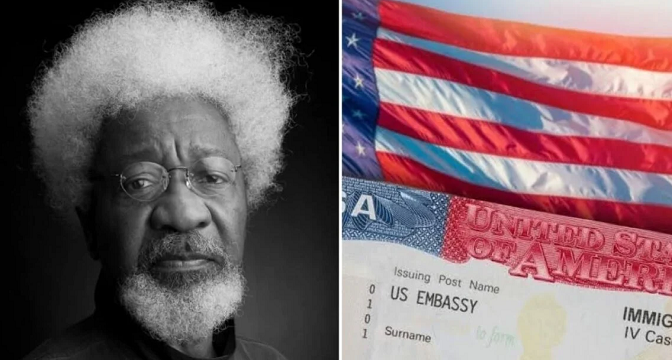
This piece is an analysis from the last press conference called by Nobel laureate, Professor Wole Soyinka, on October 28, 2025. It details possible, yet unconfirmed circumstances, that may have led to the revocation of Soyinka’s visa by the United States. This analysis is based on Soyinka’s account of events as narrated to journalists during the media parley, GBENGA OLONINIRAN writes
In his common style, the Nobel Laureate, Professor Wole Soyinka, was dressed in a white long-sleeve shirt and wore a purple jacket. His black trousers matched his black shoes as the 91-year-old, full of grey hair, climbed the stairs to the upper chamber of the Kongi’s Harvest Art Gallery, located inside Freedom Park, Lagos Island.
Shortly before then, he had met a small group of poets in his office, who presented him with an award, led by the President, Poets in Nigeria Initiative, Eriata Oribhabor.
It was a Tuesday morning, on October 28, 2025, and journalists had gathered at the gallery for the media parley scheduled for 11 a.m., which Soyinka titled, “Unending Saga: Idi Amin in Whiteface.”
He announced to the media that his visa had been revoked by the US embassy, according to a letter he got from the US Consulate General in Lagos, dated October 23, 2025, which he read to journalists.
He said people should no longer expect him in the US. “It is necessary for me to hold this press conference so that people in the United States who are expecting me for this event or that event do not waste their time. I have no visa; I am banned, obviously, from the United States. And if you want to see me, you know where to find me,” he said.
Although the Nobel laureate said he was not certain of the reason for the revocation of his visa, he travelled back in time to recollect some incidents involving him in the US.
“I’ve started looking back—have I ever misbehaved toward the United States of America? Do I have a history? Have I been convicted? Have I gone against the law anywhere?”
Green card
Soyinka spoke about the origin of his visa, which he said was issued around the time his green card “had an accident.”
“I think it’s important for me to begin by reminding us about the history of this visa, which was issued when an accident happened to my green card, so it became no longer valid. Unfortunately, or fortunately, whichever way you want to look at it, not long after that, maybe by accident or maybe it’s related or not, I got a letter from the Internal Revenue Service of the United States of America saying that an audit of my tax return was about to take place, going back about five years,” he said.
He noted that audits are done periodically just to make sure one is not cheating. “That’s okay.”
He narrated, “So I went to the embassy to say this is the letter I just received from the Internal Revenue Service. My green card is no longer usable. I don’t want to be advertised as a tax dodger owing the United States money and being chased all over the world with letters and police, and I said I needed to go in and see the audit, and that’s exactly what happened.
“I wish to emphasise that the United States Consulate staff is very, very courteous. I was treated like a human being.”
He noted that he left there without any problem, “and that was when I was issued this B1/B2 visa.”
Soyinka, who has been a vocal critic of US President Donald Trump, thereafter made reference to his green card.
In 2016, Soyinka said he had fulfilled his pledge to throw away his US residency green card and leave the country if Trump won the presidential election.
Shortly before the vote, Soyinka had vowed to give up his permanent US residency over a Trump victory to protest against the Republican billionaire’s campaign promises to get tough on immigration.
AFP reported that Soyinka said this on the sidelines of an education conference at the University of Johannesburg.
“I have already done it, I have disengaged (from the United States). I have done what I said I would do,” Soyinka, who was 82 years old, said then.
He added, “I had a horror of what is to come with Trump… I threw away the (green) card, and I have relocated, and I’m back to where I have always been” – meaning his homeland, Nigeria.
During the parley, Soyinka jokingly said the green card had an accident.
“I stressed that over and over again because there are some (people) in this country who still insist that I never got rid of that green card.
“People say I destroyed it; no, I didn’t destroy it, it just had an accident, that’s all,” he said sarcastically. “That was a joke,” he added.
“Anyways, I no longer have a green card, that’s what matters. That’s how I demoted myself by circumstances, from a permanent resident to just another tourist entry and departure,” he emphasised.
Soyinka spoke further as he continued to ponder over the reasons for his visa revocation, recalling hosting a number of American citizens at his residence in Abeokuta, Ogun State.
“By coincidence, when I read that letter of revocation, I actually had some American citizens visiting me. They came for the Badagry Door of Return festival, and from there, they came to visit me in Abeokuta. I was not there, but they were made at home and were able to go round the place and even had some palm wine. To begin with, I said, ‘Could it be that they are angry that I’m hosting their citizens just when they are considering or reconsidering, or they invited me to bring my visa for reconsideration?’”
He explained why he shunned the invitation for a visa re-interview in September 2025 because he was not comfortable with the September 11 date fixed for the exercise.
September 11 became a symbolic date in the US after the September 11, 2001, devastating terror attack on the Twin Towers of the World Trade Centre in New York City and other locations.
Soyinka, who described himself as superstitious, said he found it odd that the embassy would choose September 11 for his visa re-interview.
He said, “I declined the invitation. First of all, I didn’t like the date. Everybody knows what happened on that date, 9/11, many years ago, so it is rather unfortunate that they picked that date. So I said, ‘Sorry, I’m superstitious; I’m not coming on that day.’ And ultimately, I made it clear I was not going to apply for another date to bring in my passport. So I travelled out.”
I pleaded guilty – Soyinka
The Nobel laureate further recalled another incident that happened several years ago at an airport in Chicago, where he was carrying peppers, which were considered improper by the authorities because he did not declare them. He said he pleaded guilty.
He narrated, “And I remembered finally—two instances—which I want to make public now in case it is brought up later on.
“I remember pleading guilty at the airport one day. I was landing in Chicago. It was my first major production in the United States. We were in rehearsals at the time. And the night before, I had to dash to London and then return for rehearsals. The night before, I had gone to an Indian restaurant in London, and as usual, when I go to cold wintry countries, I always carry peppers with me.
“At that restaurant, when I was leaving, I put a few green chilies in my pockets just to keep me going when I got back to Chicago. I forgot to declare those chilies.
“So I’m warning you now that you may learn that I was convicted for carrying some small chilies. At the airport, they wanted to charge me to court, but they said I could plead guilty and pay a fine. I think I remember paying about $25 or so. So that’s one possible crime that could have been dug up. I had forgotten all about it, quite frankly, that’s my fault. That’s one.
Airport drama
“Two, the American Society of African Culture had an international conference some years ago, just in the early 70s, I’m not good with dates. It took place in Atlanta Americana, a motel. And, I had a confrontation with the police (over) some racist conduct by the receptionist, which led to the police being called.
“And this policeman came and was trying to throw his weight around. So, I could be convicted, if you like, for, shall we say, disobeying orders from law officers of the US. This was at least 30 years ago.”
“So, ladies and gentlemen, these are the only two crimes I can consider myself guilty of in all the decades I’ve been going to the United States.”
He said he did not think the incidents he mentioned could be the reason for the revocation of his visa. “So the reason had to be somewhere else,” he stressed.
“So, obviously, it could not have been. I don’t believe they would have dug so far into my murky past to unearth these two great crimes and then revoke my visa. So the reason had to be somewhere else.”
He said his mind also went to a former President of Costa Rica, Oscar Arias, whose visa was revoked earlier this year.
The BBC reported in April 2025 that Arias, a Nobel laureate, said he was informed of his visa revocation weeks after he had publicly criticised Trump, comparing the behaviour of the US President to that of a Roman emperor.
Soyinka condemned calling Trump an emperor. “It served him right. I mean, how would you be calling a whole President of the US an emperor? That is not very nice.
So I looked to see whether I had committed any similar crime. And I remembered that I referred to him as a white version of Idi Amin. Now, dictators are very difficult to please. I would have thought that he was pleased because Idi Amin was a man of international stature, a statesman, and a ‘first-class democrat.’ He called himself a liberator.”
Idi Amin was a Ugandan military officer and politician who served as the third President of Uganda from 1971 until his overthrow in 1979. He was considered a dictator in several reports.
When asked if the revocation of his visa would affect intellectual exchange between the US and Nigeria, Soyinka said countries know how to balance things among themselves.
“I want people to understand that the revocation of one visa, 10 visas, a thousand visas, will not affect the national interest of any astute leader.”
He added, “So that doesn’t bother me. One visa revoked doesn’t mean that the visa holder has become stateless. And there will come another immigrant who will be chased away. Thank goodness, at least, we have a space we can call our own. So I expect them to sort themselves out at that level.”
He said he was more concerned about other citizens. “I’m concerned about the cruelty to citizens. That’s why I’m stressing that this is not about me; I’m not interested in this visa. But what we see every day, people being picked up, congregation bases of Africans being raided, and people being hauled up, and they disappear for a month sometimes. Old women and children are being separated. That’s really what concerns me.”
Soyinka said the revocation of his visa would not affect his relationship with the US, as he consistently commended the courteous relationship he has with members of the US embassy.
He assured them that they “are given permanent visas anytime they want to visit the autonomous republic of Ijegba, situated in Abeokuta. There will be no reciprocal conduct from my principalities.”
He advocated the development of African nations to give room for egalitarian bilateral relationships and not dependent relationships.
“We become compromised through dependency. It’s a lesson that we should all take to heart.
“The answer is to diminish dependency so our relationship is based on mutual requirements of supply and demand on an egalitarian level, not as aid, not as concessions, not as patronage. This really is what Nigeria should concentrate on, and of course, the government has the central role to play in achieving this.”
While presenting the Grand Patron of Muses Award to Soyinka before the parley, the President, Poets in Nigeria Initiative, Eriata Oribhabor, hailed the Nobel laureate’s contribution to literature.
“Prof. is a grandfather, and as an inspirational leader in the literary world, we all look up to him and draw inspiration from him,” Oribhabor said.
Responding, Soyinka appreciated the team and commended the growth of young poets in Nigeria.
“I know that there is a young generation which is coming up and which is very much at home with the very concept of poetry. That’s a great advancement,” he said.
All rights reserved. This material, and other digital content on this website, may not be reproduced, published, broadcast, rewritten or redistributed in whole or in part without prior express written permission from Third Lens.
Contact: theeditor@thirdlensng.com